Sunday, July 29, 2007

Lido di Jesolo: a day by the seaside


On a hot day in last week I decided to take a day trip from Venice to Lido di Jesolo. I caught the motonave (a double-decker passenger ferry) from Riva degli Schiavoni, and enjoyed a pleasant journey cruising over the waters of the lagoon, with a very welcome breeze.

The ferry's terminus at Punta Sabbioni was packed with day-trippers travelling in the other direction, heading from Lido di Jesolo into Venice. There wasn't anything to see near the ferry stops, just a car park, a newspaper/tobbacco shop, a small bar, a souvenir stand (lots of shells), loos and a row of bus stops. I bought my bus ticket at the newspaper/tobacco shop and joined the smattering of people – including some Italian children who seemed to be making the journey unattended – waiting for the Jesolo bus, number 5 as the tobaccanist had helpfully informed me. Other buses seemed to be heading off for nearby beaches. The bus arrived; the Venice-bound crowds surged off, we took our seats and headed for Jesolo. It was a comfortable air-conditioned ride and an interesting chance to see this long peninsula, the Litorale di Cavallino. I had read that it was popular with German campers, and I saw plenty of evidence. Men getting on the bus sweaty and topless, shops and businesses with advertising signs only in German ('free wine tasting' seemed the most common).

I hopped off the bus in Lido di Jesolo after spotting a big tourist office (later on I was glad I hadn't waited until the bus station). I made my way back to this 'Palazzo del Turismo' and collected maps and information.

On a hot summer day there was something rather unreal about Jesolo. Like an episode of The Prisoner, but without the interesting architecture. Everything was sheltered, safe, 'nice' and repetitive. Later I tried to 'escape' a few streets inland to reach the bus station. But like Number Six's attempts, mine failed. A couple of minutes after I'd left the tourist shops behind, the pavements ran out. I was following streets marked on my little tourist map, but they simply weren't manageable on foot. Surrounded by construction sites and dual carriageways, I was forced to retrace my steps. I did find the bus station, but it seemed that tourists are simply not expected to stray that far from the beach.

My main impression of the beach was 'niceness'. The manicured sand, the neat rows of sunbeds and uniformly-coloured parasols, the little chalet-style changing rooms, the regular cafes, lifeguard towers, play areas. Jolly, sandy and worryingly tanned children and adults showering the sand from their brown bodies before heading the few yards to their accommodation. Everything seemed so safe and controlled it was hard to imagine anything bad could happen. True, when I arrived at the beach I came across a woman who was injured or ill. But she was already lying down, surrounded by helpful attendants and receiving first aid, while more uniformed first-aiders jogged towards the site from their stations along the beach. No panic, no fear, no pain, just a calm hush and prompt action.

I saw the beach in the middle of the day, so I didn't see any of Jesolo's famous nightlife. I did see a marvellous exhibition in a pavilion on the beach though: this year's sand sculptures festival. The theme was the Far West, and sculptors from all around the world had created large evocations of the Wild West, from dime novels to historical characters. There was even the Battle of Little Bighorn recreated in sand.

Although Jesolo is popular for its nightlife and organises lots of events for summer visitors, I can't say I was impressed with the calibre of these entertainments (sand sculptures excepted of course!). I don't think that 'Sexy wrestling'(accompanied by photographs of sweaty nearly-nude women) should have a place in modern society, and certainly not in a family holiday resort. Jesolo is keen to boast in its tourist leaflets that it hosts a regional beauty competition each year – and also considers it worth advertising the fact that a former Miss Italy came from the town. I opened the website to the local water fun park – very much a family attraction – and found myself confronted with more pictures of women clad only in pants. Why a theme park for children should consider it appropriate to host a 'pants' catwalk parade I have no idea. If you're taking your little ones, you might want to check their calendar first. I suppose these are only manifestations of common Italian cultural attitudes, though. Women may be 'equal' - and many of them extremely businesslike and successful – but every time you turn on the TV you'll see showgirls simpering in bikinis and wagging flirtatious fingers at viewing families. And I suspect that a holiday resort like Lido di Jesolo is exactly the sort of destination where those uncritical TV viewers spend their summer.

Despite my doubts about its feminist credentials, I didn't find Jesolo as unpleasant as I expected. It wasn't as crowded, for a start. I suppose ten miles of beach is enough for all the visitors. And perhaps I had been expecting the kind of faintly threatening atmosphere you find at seaside resorts in Britain.

I enjoyed a good lunch at Il Fagiolo (via Bafile 203), a friendly restaurant with a rustic-style interior and tables on a shady terrace by the road. They had pizzas at cheap prices, seafood and pasta. I chose a large and healthy salad, accompanied by the lightly sparkling house wine and lovely warm bread and followed by some decadently rich chocolate mousse. Definitely a place to recommend.

The boat trip back to Venice was enlivened by a big cruise ship, the Emerald Princess, which entered the narrow lagoon entrance just as our ferry approached. The big ships dwarf the lagoon and are always a surreal sight, with their little passengers lining sundecks high above the islands and buildings.

In conclusion: Jesolo seemed a safe and sheltered place to satisfy all the desires of a beach holiday. If you like that sort of thing. Personally I prefer sightseeing and culture, and found the niceness of Jesolo rather eerie. But I could see its appeal, particularly to families with children who want to relax for a week. It would also make a good sun-sea-and-sand stopover at the end of a sightseeing tour of the Veneto.

> Jesolo tourist guide

Sunday, April 15, 2007

Venetian Journal - Moving to Venice

For the moment the Travelling Blonde has slowed down the travelling. Having rented a tiny flat in Venice I'll be spending the next few months getting to know the city better, and exploring the surrounding area: the lagoon and the Veneto. For rather more helpful reports on Venice, see the web resource I'm compiling: Italy Heaven's guide to Venice


Living in Venice – the practical stuff

I arrived on an early morning flight from Stansted to Treviso; a plane loaded with fourteen-year-olds dressed (and made-up, and hair-tinted) like footballers' wives. The journey went smoothly and on arrival everything was a posto as the Italian say. I picked up my keys and made my way by vaporetto to my temporary home in Cannaregio.

After a day spent unpacking and shopping for household stuff and food, I headed out in the evening to meet my one Venetian acquaintance and enjoy a drink in a nice bar close to the Rialto markets.

Over the next few days I dealt with practical things – such as the discrepancy between the electricity sockets in the flat and the plugs on appliances. It takes considerable detective work to resolve problems like this in Italy, but after several outings with an adaptor in my pocket I managed to buy some more, so I can now operate more than one appliance at a time. Best not put on too many though – have you ever wondered by tumble dryers are so rare in Italy? Because households are limited to certain electricity levels (I believe you can pay to be put in a higher use band). Using too many appliances will blow the systems. Where I lived in Rome you had to turn off the tv and some lights in order to use the washing machine. I once worked in an office where the in summer it was impossible to use both the air conditioning units and our computers.

Dodgy electric systems are typical in Italy – even in smart hotels you'll find odd wires hanging out of walls. After a week in this Venice flat the electricity blew and I had to spend two days with no lights, heat, cooking or hot water. When the electrician returned from holiday he showed me a socket totally eaten away with corrosion from the damp rising through the walls. Sparks had been flying out. The combination of Italian electrics and water in Venice must be absolutely lethal.

My ground floor flat is indeed very damp, but that wasn't a particular surprise in this city. Venice presents its own particular problems. High buildings and narrow lanes make mobile phone coverage limited, for example. The people over the lane from me have to lean out of their window to use their mobile phones.

The lack of cars makes the town quiet, but sounds of voices and radios are magnified as they echo around the restricted spaces. When those same neighbours play their favoured Italian pop and rap loudly it is hard to concentrate on my work. During the night, though,it is deathly quiet here, since I'm off the main thoroughfares. The noise only starts up again in the morning, when the rubbish men make their circuits of the lanes with handcarts, collecting the plastic bags of refuse that residents leave outside. They meet up with their rubbish-collection barges on the canal at the end of the street.

My lane is short but wide; in the daytime a little bit of sun reaches my windows though it doesn't penetrate. Still, I've bought a plant to sit on the external window ledge, between the glass and my mosquito grille. Most window ledges around here are alive with plants and flowers. From the windows on higher storeys, washing emerges on lines to waft about over the canals. Coming home from the supermarket with my baguette one morning, I looked up as I was crossing a metal bridge and saw an old lady at her window, preparing artichokes on the window ledge. Old women in Italy spend a lot of time looking out windows - next time you're in a piazza, look up and see how many faces you can spot looking down. One house near me has an old wing mirror stuck by their window so they can scrutinise their visitors on arrival.

Terraces and balconies teeter upwards when you raise your eyes, and there are also a lot of gardens hidden away behind high walls, betrayed by the tops of trees or by spilling waterfalls of wisteria.

There's animal life hidden away, too. The little pet dogs of Venice are impossible to miss. Venetian cats are plentiful too, though they sneak around more furtively (perhaps they're chased by the dogs). That's not all there is though. A couple of days ago I saw a woman emerging from her front door with a big fluffy white rabbit in a basket. And yesterday a young boy walked past clutching a wriggling ferret.

As well as rejoicing in being here, I've been fascinated by the local details and sights: interesting things like a boatload of long timber piles for buildings like those used as foundations throughout Venice's history.

A canal close to my new home is being dredged, with works taking place to stabilise the banks – some of the constant repairs it takes to keep Venice above water. A narrow canal nearby has been totally drained, and when you peer through holes in the protective canvas, you can see men at work in their bright orange jackets along the empty canal, where boards now cover the remaining mud. Must be a very smelly job.

This is a very mixed area, Cannaregio. It stretches a long way; from the railway station almost to the Rialto. The main route linking the two, expressly cleared for tourists into the broad Strada Nova, is a noisy hell-hole. A Macdonalds pumps out nasty music, nasty litter and chaotic customers. At the Easter weekend the route was rammed solid with tourists trudging along towards the tourist sights - evidently too cheap to catch a ferry for the glorious trip down the Grand Canal.

My home is on a clearly defined island with only a few bridges as exits. It takes ten or fifteen minutes to reach a supermarket only fifty yards away.

Getting to know your new area is always an adventure with frustrating moments. In Italy this is multiplied by a thousand. Shops are very secretive. If you want a hardware store, you will have to ask someone, or trawl the streets during a time when shops might be open (not as often as you'd think) and hope you see one. Once a shop closes and the blinds descend you'll be none the wiser as to their business.

So far I have found an expensive but useful household type shop, where I've bought a rubbish little electric kettle for about £14 (they just don't understand such things here; this one doesn't even switch itself off. A better one would have set me back twenty quid). There are several 'euro' shops selling cheap stuff. I have tried the pizza from a nearby take-away place and found it very nice and cheap too. What's more, you can ring up and order, and they'll even do deliveries. I've even found a store which stocks decent chocolate chip cookies.

One of the biggest difficulties in settling in has been getting internet access. It's terribly expensive here in Venice, although it is worth shopping around. I finally found one place with free access for 30 minutes a day, but no connection for laptops. My final solution was to use my prepaid Italian SIM card on the Tim network. It took a lot of working out but now I can connect via my mobile phone. In case this is of any interest to anyone else, I will make a separate entry on the Italy Heaven blog with some tips.

I've enjoyed several indulgent meals, in restaurants which i will review for the website. On my second day I ate lunch in very sunny spot on Fondamenta della Misericordia - a very nice area to wander or to go out in. Walking past a week later I was recognised and greeted by the waiter – the first time I've been recognised and greeted locally – a satisfying moment.

Escaping the Easter tourists I've made some great excursions around the lagoon, which I will write up in future entries.

Thursday, March 29, 2007

From Venice back to Gatwick - March 2007

Day 5: Back to the UK through Marco Polo Airport

> Previous day: pottering around Venice

Once more I took the ATVO bus between Piazzale Roma and Marco Polo Airport. I noticed that I was the only passenger to receive the driver's assistance with getting a suitcase onboard (and again the other end to take it out of the luggage hold).

Once more I appreciated the calm atmosphere in the departure lounge – so different from budget flights where everyone is desperately queueing for ages. I was a bit miffed with Marco Polo Airport, though. I had been told cheerfully the day before (by a Venetian) that Venetians are a sly lot, and when I was told at the BA desk that they'd 'run out' of regulation see-through bags, and was directed to a newsagent where I had to pay 30 cents I was sure it was a racket. (During my visit, incidentally, the headlines in Venice were all about a car-parking 'racket' – yes, the English word – in Venice. Oh, and bedbugs in hotels.) I've since heard of someone encountering the same plastic-bag problem at Bristol Airport – though I'm not sure that proves it's not a racket. Since it's airport security who insist we use the bags for our liquids, it seems only fair that they should provide them. At Stansted I've always been handed them (free) at the check-in desk or at the security barrier.

The BA plane (female pilot) was fairly empty. Once again I relished the free food and drink, stretched my legs out in the space provided and felt no nostalgia for those crowded Ryanair planes. There were fabulous views of the alps (so many of them...). I sat sucking boiled honey sweets that I'd bought from a monastery shop in Florence and listing all the great things I could do once based at my new Venetian flat.

Wednesday, March 28, 2007

Pottering around Venice - March 2007 trip

Day 4: Wednesday - Pottering around Venice

> Previous day: A trip to Treviso


In the morning it occurred to me that I hadn't even been near St. Mark's this trip.
Tea and cake at the Rialto, Venice
After viewing the studio I was thinking of renting I wandered to the Rialto and enjoyed tea and cake at a canalside table next the the bridge. I watched some men manoeuvring boats loaded with boxed goods for the nearby shops. My biro ran out as I was writing notes, so after crossing the bridge I purchased a new slidey pen at a souvenir stall. Walking back in the direction of San Polo I purchased a nice fresh roll (30 cents) for my lunch at a tempting bakery. Then I was enticed into a stationery shop selling fancy notebooks and cards.
Luggage conveyor belt
I didn't do any hardcore sightseeing in the afternoon. I visited Piazzale Roma on a quest which failed. Alongside the bus stops is a canal where boats pull up to load/unload travellers' suitcases. These are lifted on and off the boats by an extendable conveyor belt. I find the process an intriguing example of how Venice copes with its unique logistical problems. Sadly, the conveyor belt wasn't operating at the time, so I failed to shoot any interesting footage.

From Piazzale Roma I headed south to look at some of Venice's twentieth-century architecture, which makes an interesting contrast with the rest of the city.
Modern architecture, Venice
Next I sat myself down and enjoyed a lovely freshly-squeezed blood orange juice in the sunshine outside a nice little bar in a tiny square. Sitting in the sun in the campiello, sipping my spremuta and writing notes, I listened to the noisy chirping of sparrows, contemplated a forthcoming rendezvous and decided I simply had to rent the flat I'd viewed. The idea of a life like this (albeit temporarily) was just too seductive.

Much later, after dark, I bought some exciting chocolate gifts in a shop near San Toma, and took a trip on the vaporetto. Alighting at St. Mark's (it just didn't seem right to visit Venice without passing the Piazza) I walked towards the Rialto. I inspected the exterior of my new flat (the lane was satisfactorily quiet) and then caught the vaporetto back to my holiday accommodation. This was an exciting trip – I saw three Grand Canal palaces decked out for parties, with guests in costumes, flaming torches and even two liveried trumpet-blowing heralds.

> Last day: back to the UK

A day in Treviso - Venice trip March 2007

Day 3 - Tuesday: Venice to Treviso by train

> Previous day: a tour of the islands


This was just a four-day trip, and I was already panicking about not being in Venice for long enough. One of my goals was to find a flat to rent for a longer stay, and I hadn't even started looking. I spent half the morning nervously considering letting agencies (but they're hard to locate, as are all addresses in Venice) and making notes. The most promising one (as recommended in Time Out) was already closed at 11:50. So I decided to go to Treviso. I wouldn't have a whole day for sightseeing, but enough to take photographs and make notes. And it was another glorious day - blue sky; hot sun.


I just missed a train and couldn't be bothered to walk to Piazzale Roma to investigate buses. Instead I hunted for food.


I was very happy to find a branch of Brek on Lista di Spagna. This decent Italian chain was a reassuring sight among the tourist traps. A bar at the front sold sandwiches and fruit juice. Further back was a full self-service restaurant with pasta dishes (3 per day), salads, meat dishes, fruit salads etc. You could fill a glass of local Veneto red or white wine from self-service taps for €1.10. I didn't really fancy wine but I couldn't resist the opportunity to brag about it to English friends. I ate pappardelle ai 4 formaggi (€4.50) – a little soft and salty, perhaps, but fine for refuelling purposes. The restaurant even had a few tables outdoors in a little yard. The toilets weren't very nice though.


I caught the 12:50 train for Treviso, arriving at 13:27. I bought my single ticket from a machine; it cost €2.20. You wouldn't get far for that in England. As the train crossed the rail bridge over the lagoon there was a hazy view of distant snow on the mountains.


Treviso


Arriving in Treviso I followed signs through an underpass to the centro and walked further than I had expected towards Piazza dei Signori, the heart of town. Before getting there I took a diversion to the Church of San Nicolò, stopping to buy an ice cream with zingy citrus flavours to cool me down. It was a lovely cheap (90 cents) way of getting back into an Italian mood. Having selected lemon the motherly lady behind the counter recommended adding some ACE, an popular Italian mixture which I'm never quite sure about (I believe it's orange, carrots and lemons; I used to think the name referred to the the first letters of the ingredients – arance, carote and what?? but perhaps it's the vitamin content). It tasted lovely and was the perfect thing in the hot weather. The church was impressive and ridiculously elongated. It was, of course, closed with no intimation of opening times. So I resumed my course towards Piazza dei Signori. I was concerned that the tourist office might still be closed for lunch too but it had reopened at 2pm (I was glad of the pauses for lunch and gelato).


The young girl staffing the tourist information office tried hard but didn't speak terribly confident English. I waited while an English-speaking couple interrogated her about places to watch sport on tv, and the location of betting shops (some inventive descriptions to convey their meaning to her). Speaking Italian, I found her much more able to help. Friendly and chatty, she produced extra maps and described the town's attractions. She added that you could see most of them in an hour which seemed a rather modest statement. Some of the information about the province was very tempting.


I saw my ideal dress in a shop window along Calmaggiore, the (relatively) busy street leading to the cathedral. It was out of my price range however, so it was probably a good thing the shop was closed for a long Italian lunch.


I was disappointed with Piazza del Duomo (a car park and busy road, with handfuls of loitering students) and also with the Duomo itself – it had obviously been rebuilt at quite a late date so didn't have the historic charm I was expecting. It too was closed so I opened my 'Treviso, city of the waters' leaflet and set off on one of the recommended strolls.


This led me along some very pleasant little lanes and canals, past two moving waterwheels – I was going to saw 'working' but although they were operating I'm not sure they fulfilled any industrial or energy-generating purpose (it would be great if they did provide electricity though). A little island surrounded by water is the base for the morning fish-market, which had packed up and gone home. A fish sculpture sticks out of the water alongside the road.
Treviso was quiet in this early-afternoon lull, with a few smartly-dressed professionals on their way to or from lunch and several cyclists wheeling around the quiet streets. The arcaded streets provide great protection for pedestrians from blazing sun or torrential rain.


Despite the air of prosperity (even wealth) and the much-vaunted north Italian efficiency, the 'closed for lunch' encounters reminded me of many past day-trips further south. Arriving at the Church/Museum of Santa Caterina, eager to see the frescoes by Tomaso da Modena of which I had read much praise, the Italian curse struck again. The church is being restored. The frescoes can't be visited. Nor can the Titian. Actually, most of Treviso's museums seem to be under restoration and rearrangement. Still, I paid my small entrance fee and admired the paintings in the museum's open galleries.


I rather liked Lorenzo Lotto's Portrait of a Domenican, who appears to be writing his accounts – one hand is protectively across his papers, alongside a pile of coins and the keys of his calling (the guardian of the convent of San Zanipolo in Venice). I also much admired the pretty gardens that formed the background to a Concert in a Villa by Ludovico Pozzoserrato.


A short walk from the museum was the church of San Francesco; a nice cool refuge from the sun. Although not quite as dramatic as San Nicolò, this is another lofty brick structure and featured a large version of the wooden ships-keel roofs I've recently seen in Venice and Mazzorbo. There are more winged angel faces here, painted onto a column, which remind me of the faces I found so creepy in the Accademia. In the smaller chapels were faded medieval frescoes by forgotten artists; like the sad attributions you see so often: Pittore Veneto (Veneto painter) etc.


The stroll back towards the heart of town was picturesque, passing along arcaded lanes (with hints of fresco) and over a pretty bridge. I visited the Duomo and found the interior matched the neoclassical portico. However, the crypt contained some truly old wallpaintings. I dug out my last small change to pay the 30 cents required to illuminate them. Unfortunately, when I headed back upstairs to admire Titian's Annunciation I found that another 30 cents was required. So I had to view it as best I could in the shadowy church.


On the way back to the station I stopped off at San Nicolò, now open. Again there were some sweet frescoes by Tomaso da Modena (who I will have to look up) and less-remembered artists.


I'd enjoyed wandering around Treviso with its secretive waterways and arcaded streets. I passed several tempting bars and cafes, and thought it would have been a nice place to spend an evening or two.


A welcome spremuta di arancia (freshly-squeezed orange juice) and it was time for the train back to Venice. Unlike the smart modern carriages of the outward journey (a double-decker with a display informing passengers of the speed, temperature and punctuality) this was a terribly old rickety thing. After the sunshine and Italian-style refreshments of the day (pasta, wine, gelato, spremuta) I found myself dozing off during the short journey.


Nevertheless I found the energy to pop into that promising estate agency on my way back to the flat. They didn't have anything ideal on their books but I arranged to view a small studio in the following morning. A successful day.

A short video clip I made of Treviso:


> Next day: Pottering around Venice and decisions in the sunshine

Tuesday, March 27, 2007

Mazzorbo, Burano and Murano - Venice trip March 2007

Day 2 - Monday : A tour of the islands

> Day 1: From London to Venice

Currently writing my journal on the LN ferry to Mazzorbo and Burano. Can see snowy mountains; a glorious day. The light is incredible this trip. I walked to the Fondamente Nuove stop across the Rialto and sometimes during the walk I could hardly breathe for admiration of the town's beauty. Gondoliers perched on bridges, old couples in suits and furs out buying bread, the smell of coffee (normally don't even like it!) spilling out of bars, the steel prow of a gondola sliding into view from under a bridge, Santa Maria dei Miracoli etc.

Mazzorbo

I got off the boat and walked past the occasional cycling resident back in the direction the ferry had come from, past picturesque houses and fishing nets. I headed for the old campanile I'd seen from the outdoor seat of the ferry. Santa Caterina was a lovely old church with a wooden arched ceiling, irregular brick walls, a worn red and white marble floor and an assortment of decorative features from different eras. There was no-one in sight, but this was the homely safe sort of place where offerings are left in an open dish. My only reservation about Mazzorbo was the persistent buzzing noise – of planes landing at the nearby airport and of – much, much worse – mosquitos.

The path towards the Burano bridge headed along grass verges with flowers and white butterflies dancing around. Some local people were sitting under an awning alongside the path. Given the homemade banners beside them and all around the island, I deduced they were forming a peaceful protest against a new projected communications mast. A man cycled past and was greeted familiarly, before being asked if he had a few hours free to take part. A short distance along the path three men were standing around chatting, their fluorescent tunics identifying them as 'Polizia locale', there to keep an eye on the protestors, I assumed.

Burano

I was tempted into a posh little restaurant called Riva Rosa, attracted by the tables outside in the sun by the colourful canal. Staff – all charming, English-speaking and mostly handsome – produced a lovely vegetarian dish. I know if I'd been travelling with friends we'd have been tempted by the wine list, as were fellow diners, and would probably have spent a tidy sum and most of the afternoon basking in the sunshine and quiet views.

However, the lovely sunny weather was ideal for appreciating for Burano's brightly-painted houses. Walking along with my coat over my arm I noticed a remarkable amount of attention from men. This year's fashionable smock and leggings look seemed to go down rather too well with Burano's menfolk. I remember a friend in Rome theorising that Italian men go a bit crazy in spring, after months of seeing the female form covered up in giant inflatable winter coats and scarves. Certainly the mere hint of woman was bringing men out of their houses on the Venetian lagoon. One middle-aged man descended from his front steps to greet me.

Despite the tourists who roam their streets all day, Burano still feels like a village or even a family home. Many households were drying their laundry outside in courtyards and lanes, and I watched one housewife hanging her wet sheets right across the street from her house, against the wall behind the church. In the main square a girl in dressed in alternative fashion sat lace-making outside a shop, which made me hope that the guidebooks' pessimistic comments about a dying art might be premature. The church being closed for lunchtime, I explored more of the little lanes and canals. It's not hard to get away from the tourist groups, although you'll encounter the odd photographer prowling every so often. I spent some time myself trying to get the best photograph of the canals and of Torcello over the water against the lovely mountain backdrop.
> My previous visit to Burano and Torcello

Return to Venice via Murano

On my way back to Venice, after marvelling at a man in a red gondola who was travelling across the lagoon from Murano to Burano, I got off the boat in Murano. I had recently broken a glass ring I bought here, so I was on the hunt for a replacement. I wandered for a while, and discovered that the island is surprisingly big, with some rather grand villas hidden away off the main canal. I looked around one or two glass shops, rather impressed by the range of products (from beads to dragons), then it was time to return on the vaporetto to Venice.

> Next day : a trip to Treviso
> Venice tourist guide

From London to Venice - March 2007

Day 1 - Sunday: Arrival


3:50 alarm clock. Walk through the City of London to St. Paul's to take the number 8 bus to Victoria. Revellers after their night out, bleary eyed. Some Russian-looking girls and a young man sitting awkwardly next to a pool of sick left by a previous passenger. The Gatwick Express was a smooth journey but without a trolley service (I needed tea). It was a scenic journey; still night on the right-hand side of the train, the sky turning morning blue on the other. Four vapour trails of aeroplanes were lit up by the still-invisible sun. Ate a very welcome cheese and marmite heated roll (good idea) at the airport, came out of the loos to find the information board was displaying my gate; walked to there (15 minutes) to find there were no other passengers there. I was afraid I was the last and everyone else had boarded, but in fact I was the very first. Eye-opening relaxation about boarding on a scheduled airline with prebooked seats.

The journey was fine. Being used to Ryanair, I found it exciting to get free food and drink – even the roll accompanying my smoothie was so disgusting-looking I saved it for later and never ate it. Asked for tea, whisky and coke. Only drank a little of the whisky (probably reeked of it though!) but the combination woke me up. The couple next to me were as depressingly stereotypical as last time (that time they had matching his and hers mags: his was full of oiled snogging lesbian pics, hers of celebrities). These were older than me, but he had a handheld electronic toy (something to do with football) and she was engrossed in a magazine comprised of many pages comparing the thighs of 'celebrities' and a Q&A with Hugh Hefner. Very saddening.

I had chosen the correct side of the plane during online check-in – from the right-hand side I had a superb view over the southern lagoon with buildings/farms/shacks stuck out along causeways and marshes in a place where lagoon and land seemed hard to distinguish between. Then over the lagoon between Venice and the mainland with amazing views of the city and snowy mountains. At that point I felt that this trip was already worthwhile.

Marco Polo Airport was modern, and reasonably sign-posted with newsagents and bars. But there were long queues at the ticket desks for public transport. I defeated a dreadful local queue-jumper thanks to my years of experience in the jungle of Rome. I had actually to run over her feet with my suitcase before she gave up her determined attempts to edge in before me. Without a word or glance she then slotted in behind me; the English girl there being too English to stop her (we just exchanged pained English glances).

I took the ATVO bus outside the terminal. I took a photograph for the website as the coach rolled up -'Smile!' the lounging drivers behind me called out to their colleague. It was crowded but I got a seat. No seatbelts. The journey into Venice was very short – 20 minutes on the timetable.

I collected my plastic abbonamento from the ACTV office at Piazzale Roma, from a girl in a secret little office. This is a great thing. You have to pay for the initial photo-card and buy a month's season ticket (which is about the same price as a tourist 3-day ticket). From then on you're entitled to the same discounted rates as residents of the Veneto (10 single journeys for euros, for example).

Then I caught the 82 vaporetto to my rendezvous at San Tomà. I met Enrico who had the agency keys to my holiday flat. He wasn't what I'd expected: young, scruffy student type, very friendly. He showed me to the flat, we sorted out thekeys and so on. I was very pleased with the flat and location. It boasted a kitchen-in-a-cupboard which I found rather appealing.

I was on a high from the tiredness so instead of being sensible and sleeping I walked off to the Zattere, took the 82 past the Giudecca and San Giorgio to see if I could see the mountains with snow. But either it was too hazy or the viewpoint was wrong. Next I took a fast boat back to Piazzale Roma to the supermarket, grabbed a random selection of food and walked back. I made tea, ate a roll and some apple strudel, showered, then it was time to head out for the evening. I enjoyed a nice aperitivo at an outside table in Campo San Giacomo dell'Orio.

> Day 2 - a tour around the islands
> Venice tourist guide

Thursday, July 06, 2006

Train from Venice to Rome

Venice & Rome, May 2006: Day 5
> Previous day: Venetian glass, art and shopping; Murano and Dorsoduro
I had worked out that it would be probably be quicker to walk to the railway station in Venice than to take a vaporetto along the winding Grand Canal. But the thought of pulling my suitcase down narrow lanes and over bridges didn't really appeal, so I set off early and enjoyed one final boat journey.

I arrived at Venice's station - Stazione Santa Lucia – in plenty of time for my Italian Eurostar train. As a solo traveller it can often be difficult stowing your luggage away and finding your seat number when everyone is piling onboard, so I prepared myself as best I could. The timetables displayed inside the station gave me an indication of the normal platform for this service. Then train plans on noticeboards on the platform depicted the normal formation of the carriages, so I positioned myself and my suitcase and waited.

When the large train arrived I was glad of my forethought. Luggage space was surprisingly limited, and I had to compete with porters loading on large piles of cases (I wondered if this service was open to independent travellers or just to lucky tour groups). I discovered a convenient storage space between seatbacks for my suitcase, and relaxed. I found my seat (all seats on Eurostar trains are numbered and reserved) and had made myself comfortable by the time my fellow-passengers arrived, competed for their seats and panicked over their luggage disposal.

The direct Eurostar train takes about four and half hours to travel between Venice and Rome, so I was pleased to find that my neighbours were a quiet and pleasant group: a Canadian couple and an Australian quartet, all middle-aged. We were able to chat about Tuscany (the destination of the Australian couples) and about the relative merits of ice hockey, cricket and Aussie Rules, or to read peacefully.
> Trains in Italy
I had booked my seat online a few days earlier for €39 (saving a few euros with one of the special offers; if I had booked earlier I could maybe have saved more). I had chosen a window-seat, albeit facing backwards, so I was able to enjoy the view as I travelled south. I had selected Trenitalia's 'ticketless' option, which, as the English name suggests, means you can travel with only a printout of your confirmation, or a reference number. The ticket inspector (capotreno) has a look at this and then prints a ticket for you when they arrive. I used to be nervous of this system, but it's always worked fine for me (admittedly a couple of times on previous journeys the inspectors' computers weren't working and they couldn't check my ticket, but my information was accepted regardless. Oh, and once a young male inspector felt the need to usher me into an empty compartment to note down my reference number, but I wouldn't read anything into that.)

The journey was smooth and reasonably uneventful. My Australian neighbours alighted in Florence and a young Italian took the seat next to me. He spent most of the journey to Rome on his mobile phone, having an affectionate conversation with his uncle and aunt and detailing all his career prospects.

For no apparent reason, the train was delayed 55 minutes along the way. An announcement in Italian and in English advised us to claim a 50% refund on arrival in Rome. Lacking time, I had to leave this to the following day, when I returned to Stazione Termini and queued for an uninterested clerk, who gave me a badly photo-copied form in Italian. I dutifully filled this in, rather optimistically appending my UK address. I wasn't particularly hopeful, and as I have heard no more nearly two months later, I think I can assume this is one area where the Italian railway system is not so efficient. (Just don't get me started on the UK rail network where operators do reply to such claims, but only to deny any responsibility for the frequent massive delays).

Anyway, when I arrived in Rome from Venice I had no time to recover from the long journey. I had to race across town to the Fiocca Bed & Breakfast, where I had booked a room. The helpful owner, Andrea, met me, carried my case, and showed me around. Then I had about 10 minutes to freshen up and dash out to the theatre.

This had been the hottest, sunniest day of my holiday so far, but I had no time to appreciate the weather. In Rome, weekend theatre performances start early (a 6pm start on Saturday), and I was soon collapsing into my seat in the Teatro dell'Opera. I watched the ballet Faust, which was interesting if not wildly enjoyable. The cast is usually only announced at short notice on posters in Rome, so I had booked without knowing which dancers I would see – and I was rather disappointed to miss a Kirov star, Andrian Fadeyev, who was having an evening off.
After many Italian negotiations ('We're waiting to hear from a friend,' 'I'm the other side of town,' 'Let's speak again after 9,' 'We're running late, can we meet after dinner?') I managed to meet up with friends at around 11:30 for drinks. I'd forgotten how late things happen in Rome.

First I had to brave the replacement bus service, which is replacing Metro line A in the evenings for the next couple of years. This was crowded and unpleasantly sweaty ... next time I'll try to avoid the service.

We walked to San Lorenzo, a popular and scuzzy student area where young drinkers, much scruffier than your average Italian youth, line the pavements outside bars and 'Irish pubs'. After drinks - introducing both 'pints' and cider (sidro, I believe) to the Italians - we set off again for a very Roman experience. The Circolo degli Artisti is a kind of young person's social club – or maybe a free nightclub – almost impossible to define in English. Down unlikely streets crammed with parked cars and scooters, this complex of buildings and gardens offers a couple of dance-floors, live gigs, a rose garden where groups of young Italians drink, chat and smoke things they shouldn't. The evening we visited, admission was free, and I was left to wonder both what the noisy venue's legal status was, and how on earth it made any money (or maybe that's not the point). There were actually a few drunk people there, but as normal in Italy, the majority were drinking little or nothing.

We caught a circular nightbus by the white Roman marble of Porta Maggiore, and I returned to my B&B after a long and somewhat varied day.

Wednesday, July 05, 2006

Venetian glass, art and shopping; Murano and Dorsoduro

Venice, May 2006: Day 4 (part 2)
> Previous entry: A Venetian honeymoon gone wrong
It was a sunny day, though windy, as I set off early to see some art. The gorgeous paintings by Carpaccio in San Giorgio degli Schiavoni provided a lovely start to the day - very refreshing for the soul after the troubles of the night.

Next on my list was Santa Maria Formosa (Curvaceous St. Mary). The church is pretty good, but personally I think the name is even better.

Then I walked northwards past the hospital (another one of Venice's most beautiful buildings, offering glimpses of ornate halls). From the ferry stop at Fondamenta Nove I took the vaporetto past Venice's cemetery island to Murano. Murano is an island most famous for its glass-makers – who were apparently pursued and assassinated by the Venetian state if they took their secrets abroad. I'd been warned about tacky souvenir shops and gaggles of ripped-off tourists but I was pleasantly surprised.
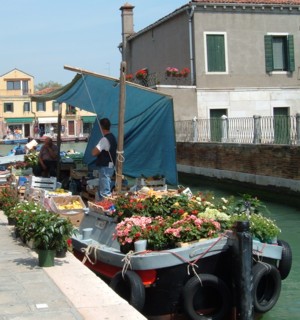
Fruit, veg and flower boat in Murano
Murano is a pleasant island, although the area around the glass shops tended to be lined with other foreign tourists. I enjoyed the more domestic scale of the buildings, and was struck by a fruit-and-veg boat moored in a canal. The glass shops ranged from tacky to stylish. I picked one which was obviously a workshop, and which displayed militant posters declaring war on 'chinese glass'. I bought a tasteful glass ring as a souvenir of my Venice trip.

I ate lunch in Campo S. Stefano, a little square on the far side of the canal with lots of outside tables laid with cheery bright yellow tablecloths. Ignoring the generous range of seafood on the menu, I opted for tagliatelle with porcini mushrooms. The meal wasn't special, but I was entertained by a bold and aggressive sparrow with eyes on my bread. It tried hopping onto my lap, snatching bread from my hand, and did eventually get away with a strip of pasta. A few tables away a loquacious red-faced man emerged from the restaurant's interior to display a dead fish to a tableful of diners, his fingers thrust proudly through its gills.

While on Murano I added to the day's tally of churches with visits to S. Pietro Martire (a nice Giovanni Bellini painting of the Virgin with a doge) and Santi Maria e Donato (super mosaics in the apse and on the floor). Even the churches here have glass chandeliers, and I also saw a glass Madonna in a shrine overlooking the canal.

I returned from Murano to San Zaccaria by taking a boat around the eastern end of Venice, including some shore I hadn't yet navigated. The journey took nearly 50 minutes, but I had an outside seat and it was an enjoyable ride. I saw several teams in boats training for a regatta.

I wanted to do some more glass-shopping in Venice, and I returned to a shop I had found previously. It was mid-afternoon but the shop was shuttered so I ordered a cold orange juice at a cafe table outside and asked the waitress when the shop would re-open. 'He doesn't have an orario' (timetable), she replied, 'but I expect he'll be back soon'. Knowing Italian time-keeping I was slightly doubtful, but I sat at my table alonside this pretty canal and enjoyed the scenery.

Sure enough, the glassblower soon returned, and helped me select several of his handmade little glass figures as gifts for my friends. 'Do you know the story of Pinocchio?' he asked me. I replied that I didn't think the whole story was very well-known in England – I, at any rate, had never heard the whole tale. So as I compared miniature wizards and courting couples, he told me story with plenty of flourish, up to Pinocchio begin eaten by a whale.

Then it was back to my hotel, glass figurines carefully boxed, to collect my suitcase and change accommodation once more. Sorry to leave the Campiello, I headed along the Grand Canal to my next hotel, the Tivoli. This was in Dorsoduro, a lovely area which combines picturesque canals and a few of Venice's greatest tourist sights with a surprisingly laidback 'local' feel. This is where young people head out at night to drink and meet friends.

I spent the afternoon exploring the little lanes and canals in the area, taking far too many photographs of every scenic corner. One of the most interesting sights was another fruit-and-veg-boat, selling fresh produce to passers-by. I saw a gondola dragged up on its side to be mended, parents wheeling buggies along, and young students sunbathing along the Zattere shore.

Dinner was a plate of pasta in a pleasant bar close to the hotel on Crosera San Pantalon. Called the Improntacafe, the place tried rather too hard to be Milanese-trendy, though service was friendly. Glass-fronted and on a busy T-junction, it was great for people-watching. I saw a blind young man feeling his way past with a cane, and tried to imagine being blind in Venice. Of all places.

A picturesque evening wandering the illuminated passageways, bridges and squares, and my last day in Venice came to an end.

On foot in Venice

I decided that one of the things about Venice which charmed me the most wasn't the art, or the beautiful palazzi, or the canals (although obviously they played a major part). I loved the pedestrian lifestyle and the friendly scale of movement. Unlike Rome, say, where only the unfortunate and the foreign use public transport, here in Venice everyone has to take the ferries. And walking isn't a third-class option; it's the norm. After the difficulties I've experienced in Rome trying to meet up with friends at night when they all hop about on scooters or in cars and I'm struggling with buses, I found the Venetian system very egalitarian. Everyone has to take the boat and to walk, it's as simple as that. Instead of roads, Venice has pedestrian lanes where people can hail their friends, and stop for a chat. It's healthier, too - I doubt there are many overweight Venetians.

> Day 5: Train from Venice to Rome

A Venetian honeymoon gone wrong

Venice, May 2006: Day 4 (part 1)
> Previous day: The Lido, a Venetian quest and a new hotel

My hotel in Venice was lovely, but I didn't enjoy the good night's sleep I was expecting. The night turned out to be memorable for entirely unexpected reasons.

Long after midnight I was woken by two fellow-guests; a German couple in a room around the corner. There were knocks, remonstrances and strings of abuse.

I don't understand much German but my tired brain began piecing together what was going on. The woman had apparently locked her boyfriend/husband out of their bedroom. He kept knocking and urging her to open the door in an exasperated undertone. She responded with a long rant in loud, sulky (and drunken?) tones. Sometimes he would get tired of arguing and go away for a while, but her loud self-pitying monologue continued regardless.

The walls of the hotel hadn't seemed particularly thin, but this disagreement made it impossible to sleep, as well as being rather more disturbing than the cheery sounds of conversation or laughter would have been. Eventually I stuck a tousled, bleary head around my door, at which point the German husband looked very embarrassed and disappeared downstairs. I actually felt rather sorry for him, as the nagging diatribe continued from within his room.

Breakfast the following morning was smart and refined, and the room around the corner was already being cleaned. It was as though this couple (honeymoon guests? Romantic tourists? The mind boggled) had never been. Until I heard other guests complaining about their interrupted sleep, and the conversation became a general comparison of notes. Some holidaymakers had complained to the night-receptionist, they said. They had been unlucky enough to occupy the room next door, and thought the loud-voiced woman must have been ranting into her mobile phone. We all marvelled at a Venetian holiday that could degenerate into such a nightmare, and piously expressed our horror and our sympathy at such a state of affairs.

The locking-out scenario certainly made a change from the other tourists I encountered: most were couples on the holiday of a lifetime, on a second honeymoon, celebrating their children leaving the nest or travelling with a new spouse. Venice didn't seem to me the sort of place you would come to with the partner in a rocky relationship. But maybe this young-ish couple thought a romantic trip would patch up existing problems? Or maybe they had learned too much about each other and the recriminations had started? Perhaps they were on their honeymoon and the bride already regretted it and was telephoning an ex-boyfriend? Maybe the local wines had caused the mischief? There was a lot to wonder about, and as I had lain there, sleepless, I started to wish I had a better understanding of German.

> Day 4 (continued): Murano and Dorsoduro

Tuesday, July 04, 2006

The Lido, a Venetian quest and a new hotel


Venice, May 2006: Day 3
> Previous day: Torcello, Burano and an evening on the Grand Canal
I was changing hotels today, moving my base from the Lido over the Lagoon into the centre of Venice. I thought I ought to explore the Lido first, so after breakfast I headed out for a walk. The Lido is a narrow strip of land separating the lagoon from the Adriatic, and I was rather disappointed that, apart from some faded grand hotels, I hadn't found much evidence of the elegant sea-bathing world of the film Death in Venice. My one expedition to the sea-shore ended in a wide street where various ugly structures blocked my view over the shore. By way of consolation I decided to visit the one historic sight my guidebook mentioned in its brief account of the Lido.

In this quiet season, outside passeggiata hours, I found the Lido's streets disconcertingly empty. Alone, female and walking away from the tourist areas I felt somewhat conspicuous. Still, I'm used to this in Italy. A few passing car drivers stared. A smirking man offered me a lift - on the luggage trolley he was pushing.

The walk along the lagoon shore was fairly interesting. Venice lay sparkling just over the waters. I watched the various types of water-traffic, passed a little boat filling up with fuel and crossed the access-road to a jetty where a larger ferry lay awaiting its cargo.

I was disappointed when I reached my goal, however. The church of San Nicolò is a significant building, the destination for the Doge's annual procession (now performed by the Mayor of Venice) of the Festa della Sensa (a symbolic marriage between Venice and the sea). But while the ancient exterior was simple and attractive, I didn't find the interior particularly exciting. I lacked a detailed guide, and I couldn't find the tomb I had hoped to discover (that of Nicholas / Nicola Giustiniani, a twelfth-century Benedictine monk who was compelled to leave holy orders in order to marry and beget heirs for his noble family before returning to his abbey on the Lido).

Returning, I passed the walls and locked gate of Venice's old Jewish Cemetery, an atmospheric and overgrown graveyard which, according to a sign, dates to the 14th-17th centuries.

Taking the vaporetto 1 from the Lido over to Venice we passed in front of a massive cruise liner, the Carnival Liberty. This dwarfed everything in the lagoon and suddenly cast Venice in a very different light. High, high above us the ship's decks and vantage points were packed with the tiny figures of passengers crowding for their first glimpse of Venice.

Back over the waters in Venice I checked into my impressive new hotel. Around the corner in Campo San Zaccaria I ate a light lunch in a little bar with a few indoors tables. Then I set off on a quest.

On my previous trip to Venice with two friends, we wandered home from dinner, hoping we were heading in the right direction for our hotel. We passed many lovely sights in the moonlight, but the most impressive of all was a jewel-like Renaissance church in coloured marbles. I remember gazing open-mouthed at this unexpected and perfect building. The image of this chapel haunted me and I needed to find it again. I studied my guidebook and maps to identify the most likely candidate. Then I set off to visit Santa Maria dei Miracoli.

The church was exactly as I remembered, and just as beautiful by day as by night. Stepping inside was breathtaking, like walking into a jewel-box. An English-language tour group were being lectured on architectural history by a young guide who confessed that the church didn't make her feel spiritual. To me it seemed magical, but maybe that's different.

The rest of the afternoon I spent wandering around Venice's lanes and canals, before taking ferries on the routes I hadn't yet experienced. I travelled along the less-touristy northern shore, past the vast walls of the Arsenal, before alighting at San Pietro. This residential island, attached by bridges to Venice, gave me a refreshing taste of the everyday. The terraced buildings here were on a humble scale, and laundry hung over the lanes and waterways. It was too late in the day to enter the church of San Pietro, which has a dramatic campanile and a pleasant grassy forecourt, but I admired the exterior before heading back along the busy Via Giuseppe Garibaldi, past the statue of Garibaldi (above a pool filled with turtles), to the Riva degli Schiavoni shore.

St. Mark's Square isn't really a buzzing or cool place to go at night, but I popped along in the evening to see what was happening. The two grandest cafes, Florian's and Quadri, had competing sets of musicians playing on opposite sides of the square – mostly lively waltzes. I decided the Quadri orchestra had a slight edge, thanks to the panache displayed by their synchronised-movement musicians. The audience was split between well-off older couples sitting at the outside tables and a motley rabble of cheaper tourists and school parties standing around behind them. I could understand why couples on their dream holiday might want to sit there, but the night wasn't warm, the piazza had a rather dead, cluttered feel to it despite the music, and it really seemed like a congregation place for tourists who had no idea where to go after dinner. (I'd recommend Campo Santa Margherita or hidden back-street bars for a livelier atmosphere and less touristy vibe).

I was staying at Hotel Campiello, which was my favourite hotel of this trip. It was smart, comfortable, good-value and offered a free internet point as well as a handsome receptionist. However, my one night in the hotel was ruined in the most unromantic of fashions. Read the next instalment of this travel journal to learn more.
> Day 4: A Venetian honeymoon gone wrong; exploring Dorsoduro

Thursday, June 08, 2006

Torcello, Burano and an evening on the Grand Canal

Venice, May 2006: Day 2
> Previous day: Venice in the rain
Sunshine! I arrived at the quay to a beautiful view: the lagoon glinting green - the warm brick-and-stone towers of Venice - a mountain backdrop, peaks capped with white snow – the sun dancing on little waves – like opening a jewel box.

I was exploring the lagoon today, so from my base on the Lido I caught the large ferry which ploughs along the outer edge of the lagoon northwards towards the islands of Burano and Torcello. Sitting with the sun and wind on my face I was able to observe the various activities of the lagoon: dredging, fishing, construction works (perhaps the controversial Moses project, against which I saw various banners and posters organising protests).

Torcello, the abandoned island, was my principal goal. But to get there you need to take a smaller ferry from Burano, and by the time everyone had piled off my boat, the Burano ferry was already leaving its jetty. With half an hour until the next departure, I explored Burano. The island is famous for its brightly-painted fishermen's houses, and is incredibly picturesque. As I snapped away with my camera, I wondered whether the locals are legally required to live in gaudy houses, for the sake of the tourist trade. What would happen if you fancied living in a plain white house?

Although maintenance works on one of the canals detracted from the views, Burano was still a very pretty and charming island. Far more real and working-class than Venice, and on a much more human scale. Although the larger canals were busy with tourists, there were also quiet alleys festooned with washing lines that were just as appealing.
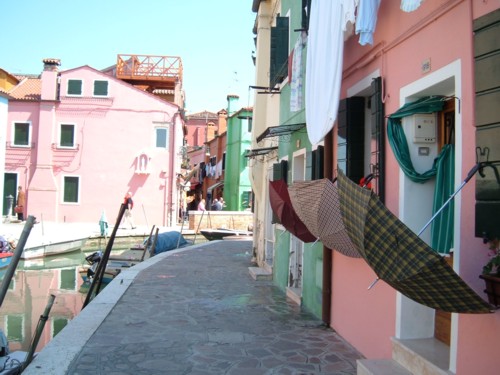
Umbrellas growing from houses on Burano
The most bizarre thing about Burano when I visited was the way in which the houses seemed to be growing umbrellas. Presumably because it had rained all the previous day, the town was full of umbrellas hung out to dry; dancing out from windows and washing lines like strange excrescences against the bright-painted walls.

Burano would have been a nice place to spend a couple of lazy hours; but I had a schedule and it was time to head off to Torcello.

Torcello is an evocative expanse of marshland, interrupted by the cathedral and town square which are all that's left of the island's busy past. I could write far more about the island, but suffice it to say that it's well-worth visiting: for its atmosphere, for the lagoon view from the campanile and for the cathedral's Byzantine mosaics. Wear insect repellent, though. I was planning to stop for lunch in a pleasant garden restaurant, but the clouds of insects put me off. I'd already been bitten once in Venice and I had no intention of providing lunch for the mosquitos of Torcello.

After returning to the Lido I made an afternoon sortie into Venice, wandering around in a daze of canals, palaces and vistas. I returned in time to take some photographs of the fine old hotels on the Lido before the sun sank. Then it was time for the Venetian evening.

A chance encounter on my previous visit to Venice had led to a rendezvous on a bridge, which led to an evening attending a party overlooking the Grand Canal (looking down on gondolas sliding past in the moonlight) and taking a private tour of Venice. So often the unplanned moments of holidays are among the most memorable...

> Day 3: The Lido, a Venetian quest and a new hotel

Tuesday, June 06, 2006

Venice in the rain

Day One in Venice - May 2006

This was my second visit to Venice and it started off in the dark and in the rain. My delayed flight arrived at Marco Polo Airport at around 10pm and I didn't see much on the ferry journey to the Lido. Murano appeared out of the night, looking picturesque, then vanished again. The Lido itself was unromantic – streets and cars rather than the canals and gondolas of Venice – but I was too tired to care about my surroundings. By now it was too late to go out for the evening, so having found my accommodation (Hotel Reiter) I did not leave again till morning.

My first day started with the ominous sound of raindrops on tarmac. It rained heavily for the entire day. So what is there to do in Venice in the rain? I soon discovered the limitations. With rain outside and condensation inside there wasn't a view through the windows of the vaporetto I took over the lagoon to Venice. And wandering the streets of Venice in the rain isn't as easy as it sounds. For a start, they're mostly narrow lanes, with room for only two people holding umbrellas to pass. Tourists in Venice aren't put off my the rain (most are only here for a day or two), and negotiating crowded thoroughfares with an umbrella while jumping puddles is no easy task. The covered colonnades around St Mark's Square had become a refuge and gathering point for hundreds of bright waterproof-clad tour groups.

Before long I found that getting around and sightseeing was far from straightforward. And with my shoes beginning to let water, the only thing to do was to get out of the rain.

So I visited the Museo Correr and the Museo Archeologico, a rambling complex containing some fine art and classical statues, as well as interesting scenes of Venetian life. The museum's facilities were inadequate, but apart from that it was a good way to spend a couple of hours.

I ate a quick, late picnic lunch in my hotel room, then braved the heavy rain once again and wandered the lanes of central Venice for a while, more from duty than inclination. I contemplated buying a new (dry!) pair of shoes to cope with the wet, then decided that I should be optimistic and hope for an improvement in the weather.

I was lucky: by the time I'd eaten dinner (a good asparagus risotto with white wine in a cheap restaurant close to the Lido ferry stop, called La Pizzeria) the evening was drying out. There were streaks of pink sunset in the sky over the lagoon. I wandered down to the waterfront to look at the view over towards Venice. An elderly drunk was singing loudly in a small park by the water's edge. He was singing in Italian, too – it's not often you see an Italian drunk. A police boat had pulled up alongside to investigate this untoward behaviour. A strangely picturesque way to end the day.

> Day Two: Torcello, Burano and an evening on the Grand Canal.

Sunday, May 28, 2006

Venice and Rome in May


I recently returned from an eight-day trip to Rome and Venice. It was a pleasant week, although surprisingly lacking in comic or disastrous events.

May is probably the best month for visiting Italy, with plenty of sunshine but without the searing heat of high summer. I experienced some weather extremes on this trip, though. My first day in Venice was memorable for the heavy rain which fell without pause from dawn until dusk. And my last two days in Rome were remarkable for a tarmac-melting, sunburn-inflicting heatwave.

Favourite hotel of the trip: the Hotel Campiello in Venice.
Best meal: a welcome plate of pasta at the Trattoria di Priscilla on the Via Appia Antica in Rome.
Worst meal: never buy the prepackaged sandwiches on the Eurostar train.
Most cliched moment: an evening appointment on the Accademia bridge over the Grand Canal.
Saddest Venetian sight: the German holidaymaker locked out of his room by his wife.
Conversational topic of the month (maybe year): the emerging Juventus football scandal.

Read on for more of my travel notes.

- Day One: Venice in the rain

Monday, May 08, 2006

A night out in Venice

We were two girls out on the town in Venice, and we'd been rather disappointed with the town's nightlife (or lack of it) up till now. So after a large meal, helped down by a generous pitcher of strong white wine, we followed our guidebook's directions to Campo Santa Margherita. This long open square is apparently the busiest and most buzzing area of Venice at night. Well, there were two bars open and a few people clustered outside, which was certainly the busiest place we'd seen so far.

The liveliest bar was the Caffè, which was crowded with what seemed to be a mixture of locals, tourists and students. We elected to drink at the bar and were enjoying our dirt-cheap beverages (a prosecco and a very good local-speciality spritz) when we had our first encounter of the evening. Three young men edged nearer and nearer, speculating audibly on our nationality, before asking if we were Finnish(?).

One of our new acquaintances was a cheery American ("a firefighter from Chicago"), travelling around Europe. One of his friends was a faintly creepy Italian who looked rather like a predatory bespectacled mole, and was introduced to us as "the man behind the man behind the man". The third of this odd grouping was a bouncy young Italian from the mainland wearing a pale pink sweater and a wide snakeskin belt which kept drawing our fascinated eyes inexorably but inappropriately towards his groin area. We politely refused more drinks, and chatted in a casual fashion although frequently at cross-purposes, thanks to the language barrier (the conversation was in English to suit J and the American boy, and I didn't feel the need to explain that I spoke Italian). J laughed across at me, and Snakeskin Belt demanded 'What are you laughing at?'. She couldn't very well say 'at you' so she simply said 'Oh, we like laughing.' Snakeskin Belt pointed at me and said 'But she's not laughing'. J told him 'she's laughing inside', whereupon he leaned towards me and said into my ear, in heavily-accented English 'I want to laugh inside you'. Our mirth overcame the outrage I was trying to convey: J and I laughed and left.

We crossed the campo to the other bar and sat ourselves down at an outside table to enjoy a more staid atmosphere. The rest of our night probably merits another blog entry, but for now suffice it to say we enjoyed more drinks (for which we duly suffered the next morning), had some politer conversation, and nearly witnessed a mysterious fight. Then it was time for the night-boat home.

Wednesday, March 29, 2006

Impressions of Venice

March 2006

* Arriving by bus, boarding a vaporetto and travelling the length of the Grand Canal before arriving at our hotel, marvelling the entire way. Just like the pictures!

* Our first evening meal in a cheap and friendly bar/restaurant we found by chance. Two free rounds of drink to entice us to wait for a table (sparkling white wine on tap, which greatly impressed our party). Nice plates of steaming tagliatelle with greens. Four desserts between three of us – one was a gift so that we could sample the cream-and-biscuits delicacy. There was a big birthday celebration at a long table nearby, with lots of thirty/forty-somethings with one child between them – typical spoiled but charming little Italian prince. A cake with candles was brought in with darkened ceremony, to the sound of 'Happy Birthday' in Italian. We very improperly drank sparkling wine with our meal and spent the first of several merry evenings.


* On our restaurant-hunt, as we explored silent darkened lanes, we suddenly came across a random alley with a heaving bar, an explosion of drunken student types milling inside and out, trying to accost us in the narrow alley, staggering and calling: 'I love you! I love you!' in their best English.

* The horror of being bitten by mosquitoes in such cold weather and so early in the year.

* On a wet night my friend was overjoyed to see two Venetian rats – fat rats they were; presumably gorged on refuse and canal-dirt.

* Being ogled by the police. Three carabinieri (military policemen) staring in the window of Florian's at us, loitering and laughing. Then peering around the other side of a column. Then sauntering behind us when we set off on our way. We speeded up to escape (did we have something odd splashed on our faces? surely being female wasn't unique around here), passing another cafe where we noticed the jazz pianist and the double bassist both staring out through the glass and grinning suggestively at us while bobbing their heads and playing their instruments. Perhaps women really were thin on the ground around St Mark's??

* During our gondola ride, the sight of a well-built young gondolier appearing suddenly on a little quay overlooing the narrow canal, and just posing there in his hat and stripes.

* The rather spooky experience of ascending the campanile of San Giorgio, where a silent and solemn monk whizzed up and down in a fast and noiseless lift. Exactly as my father remembers from 40 years ago.

* Being perversely disappointed at not seeing the sinking city's stacked duckboards in use.

* Teenage schoolboys play-fighting in the street, but stopping as we nearly walk into them, eyeing my friend up and down and promptly flashing her a dashing all-Italian grin.

Tuesday, March 07, 2006

Two girls abroad

With a new friendThanks to J for the reminders of two more 'that wouldn't have happened if we were boys' occasions. Late night drinks with the owner in a Positano bar (see photo) and an entertaining boat trip on Lake Garda. We took the boat up the lake and somehow ended up sharing the crew's delicious meal below decks. After lengthy chats in halting English and Italian, a photo-session on deck and a wickedly alcoholic dessert (liqueur generously poured) we rolled merrily off the boat to wend our unsteady but ambitious way up hills and along the shore.

Friday, March 03, 2006

Ortigia and too much Italian TV

Sicily Travel Journal Part Three
Sunday evening:
By mid-afternoon the sightseeing has taken its toll, so I head back to Casa Mia for a rest, to catch up with the football and to see a bit of peerless tv show Buona Domenica. Walking back downhill I saw many traditional 'RIP' posters pasted to the walls. These are usually put up in memory of recently-deceased locals. But one, rather peeling now, was for 'Inter' where 'tifosi nerazzurri' announced the demise of the football club. More evidence of the Italy-wide obsession is on show outside the striking modern church (apparently the church is designed like a 'teardrop' and dedicated to 'Madonna of the tears' because of a statuette in a couple's bedroom which began weeping – I love these stories ), where a souvenir stall was labelled 'Oggetti sacri' and sold football kits (Del Piero's Juve shirt etc) alongside the rosaries and religious tack.

While following the football scores using a combination of teletext and my little radio, I marvel at Buona Domenica. This programme is utterly mad, lasting most of Sunday afternoon and evening, featuring minor celebrities, miniature ballets, the latest Big Brother types and weeing puppies. Popular tunes are sung by guests and studio audience, everyone jiggling and smirking and thrusting for the camera's attention. 'Ordinary' guests wheel out tales of tragedy, showgirls wiggle and pout and there are usually games thrown in for good measure (my favourite was the limbo dancing contest for the show's guests, or possibly when couples played musical statues while impersonating piazzas in Rome).

After hearing the good news about my team, Lazio, I head out again in late afternoon for a walk over the bridge to Ortigia. I walk around the island's circumference, and explore some of the interior. It's all quite empty and atmospheric, with loads of gorgeous crumbly buildings, some of them empty and abandoned. Occasionally a second glance showed that what looked like a window box or balcony display was actually wild things making a home in a house going to rack and ruin.

Along the seashore I came across what was obviously the Sunday passeggiata stretch, by Siracusa's much-vaunted spring. Locals were standing around in groups, posing in sunglasses that were much bigger and blacker than mine. Some of the bars looked nice, but I feel rather cowardly and self-conscious walking along there alone, female and blonde, in front of all the bars and all the loiterers, trying to avoid eye-contact. I hear a 'Mamma mia' but no-one approaches me. Good thing as I have a strong feeling I wouldn't understand the dialect.

I dine in a typical local eating-place, La Siciliana. Dining out alone is can be slightly uncomfortable, but I feel at ease here. There are other foreign diners, no-one is staring and the atmosphere is friendly. I have a nicely-positioned table too. I order a pizza with funghi porcini, mozzarella and tomatoes, and am tempted by the cheap local wine, which turns out to be very nice. I make a private toast to today's goalscorers.

There are some Sicilians here too: a young man sitting opposite me in the pizzeria came in with his girlfriend, but now he, the owner, and the owner's son are all involved in a big discussion about how many goals Roberto Baggio has scored in his career.

The walls are covered with historic photos of besuited Sicilians walking around town – the Ortigia scenes aren't that different now – it's only the people in front of the faded palazzi who've changed. And the fact that now there are cars everywhere and, as I know to my cost from when I was trying to take photographs myself, balloon sellers.

In the pizzeria the owner's son is now sitting at the table of the Italian couple opposite and discussing school. When I was new to Italy I would often assume in chummy situations like this that Italians knew each other, now I understand a bit better, it seems that frequently they don't. I don't think this lot were previously acquainted. At the table next to me another Italian couple have arrived, youngsters in the made-up, sunglasses-on-gelled-head style, ordering complicated customised pizzas.

The owner is tubby and I was reflecting on how pizza chefs are generally large, testament to the quality of their pizzas and also to the fact that the rest of us should be careful not to overdo things. Then the pizzaiolo came out from behind the counter and he's huge.

When I return to my B&B, I find that the talent-contest tv show that was starting when I left my room is still going strong. It's a ridiculous programme, although some of the dancing is not bad. There's a lot of weeping and hugging. When two competitors are dismissed everyone cries. Even the tough rasp-voiced presenter is mopping her eyes: 'I've never cried on television before' she says.

Interesting fact of the day: there used to be mini-elephants in Sicily (at first I doubt the museum's skeletons but it's true).

Sunday, February 12, 2006

Rain and ruins in Siracusa


Sicily Travel Journal Part Two

Sunday is my first full day in Siracusa (Syracuse) and starts with breakfast, taken at a large table in the lofty front room of the family apartment (bedrooms are in a kind of annexe out the back). I meet a nice Canadian couple who've been in Sicily a couple of weeks already. Breakfast is a vast spread, and includes Nutella, rolls and lovely cakes.

It's a drizzly morning so I decide to start with the archaeological museum. It has some fantastic things. To plan my visit, I pick up a leaflet only to discover it contains administrative details and theory instead of actual historical/displays information. I've learnt that this is typical in Italy: councils, museums and tourist boards are all far more keen to tell you about their own administrative structure than provide any useful background. The museum plan is uninformative and doesn't have toilets marked on it (they're not signposted either). A manned cloakroom containing bags and coats (presumably those of invisible staff) refuses to take my things as it's 'closed'. I enter the middle section of the building, and a chattering group of rather sinister-looking middle-aged men and women stare at me. I presume they're staff, and they're the only ones I see in the whole museum tour. I ignore them and deliberately look slowly at all the statues in the room.

I love the museum exhibits. After initial frustration at the administrative gaps, I realise I don't need a plan: there is only one route visitors can follow, and that takes you past every single case (although there are worrying moments when the signs aren't clear and you fear you may accidentally bypass important sections). A small girl, rounding a loop in the maze, the other side of a barrier from me, looks at me and wails 'I want to get out!' I suppose it is a long and winding path but I find it fascinating. Rows of ex-votos of Demeter and Kore remind me of the ranks of modern religious icons you see in all the religious kitsch shops (like the stalls I passed outside the amazingly busy modern teardrop-shaped church). There are some lovely statuettes of girls dancing. One is leaning backwards with her leg extended in movement, and is my favourite.

Next stop is the Greek Theatre. The rain has stopped so I pull out my notebook, sit and read/write. The weather wavered as I walked to the archaeological park (via the ruins and firmly-closed entrance to the catacombs of San Giovanni). Most rewarding experiences in this part of the world require an ordeal to be passed, and in this case it is the traversing of a near-impassable road network. My route didn't seem to be designed for pedestrians – however it did take me past some splendid and mysterious necropolis-type caves and ruins, all fenced-off and unheralded.


Here in the wonderfully-preserved stone theatre a man poses his granddaughter(?) for the interminable Italian photo shoot. A small green lizard scuttles into a hole. There's a shrieking, scrambling party of young Italians, but once they've gone it's quiet again. Not only do young Italians have to do everything in a party of at least seven (unlike English school-parties who fragment as soon as is possible) but there's always a point where they have to find some prominent point – on a ruin, say, or the other side of an arena – and shout back at the teacher and any remaining mass of fellow-pupils 'Look! Look at us! Look at me!' and then the photo saga again.

It's stopped raining and now it's actually quite warm sitting. It's not sunny precisely, but there's the kind of glare that comes through clouds and hurts your eyes (and sunburns any exposed neck, as I find later). I'm down to a jumper now, having shed a leather jacket and tracksuit top. It's almost as though spring has finally arrived.

I see the caves, where doves echo around the walls. It's atmospheric in the quarries – not so nice to think about the thousands of prisoners abandoned in them though. It's all peace and lemon trees now. Best of all is the narrow spike of rock (left as they quarried around it?) which actually appears to have a ruined building on top of it – more fantasy scenery to remember.

I head back to the theatre to sit and contemplate history some more. After some contemplation, though, I become distracted by the tourists arriving, and turn my contemplation to the Italian attitude to holiday snaps. I've noticed this before (I remember a funny couple at Villa Lante, who appeared to be shooting a whole fashion album instead of a holiday snap) and here I become fascinated by the serious posing going on around me. I'm amused by an Italian couple – he's photographing her as she pouts from the stone seating, and there's the usual rigmarole of hair-tossing and showgirl-type posing. To get the photo just right though, he has to take the picture across the path, so what with their fussiness and the processions of passers-by, it's not going at all well. They're not giving up though. Once more she arranges her mane, and pouts like a model. Now they're involving someone else in taking a picture of both of them. Thank goodness they didn't ask me – I'm not sure I could handle that much pressure. As they finally move on, I notice that she's wearing a fashionable clanky belt over her tight jeans, with dangling metal links and discs. It's almost identical to some of the pre-Greek artefacts I saw in the museum earlier.

Some of the caves here, above the theatre and by the nymphaeum, remind me of the Etruscan tombs at Cerveteri – they have the same stone 'beds' in them. I'm not very clear about the order of development here. Would they have been tombs? In use at the same time as the theatre? What would the area have looked like? I re-read my guidebook and worry that I have missed the 'altar' outside the archaeological park entrance. Then I realise that I didn't miss it at all – it's not a table-sized structure, but that vast arena-scale edifice .

It's getting noisy now as an Italian tour group is enveloping me. More photo madness. A young man takes pictures of himself with his mobile phone. A family is forcing their little daughter to participate in a family shot, getting a passer by to take the photo. The girl is complaining and crying and trying to escape, but to no avail. I wonder if she's the same little girl who was upset in the museum earlier.

I move on. After the expanding crowds at the main site (glad I'm here in March: I bet most of the year is much busier), the Roman amphitheatre is very peaceful. It's very cool, too. Just abandoned, under long green grass, several types of yellow flower, purple flowers, white clover, purple-headed thistles, small, pale star-shaped blooms, a variety of grasses. Birds twittering, insects humming. My guidebook says that the basin lined in large square stones was for blood. There's no whistle-blowing attendant in sight, so speculatively I follow a small path around the outside of the arena, hoping to find away into the centre. No luck. The well-preserved entrances are barred with wooden barricades. A stick has been removed from one of them. If I was the adventurous kind, I guess I'd befriend the local youths, and come back at night to clamber in.

Part Three: Ortigia and too much Italian TV

Monday, February 06, 2006

Slow train to Sicily

I spent a memorable week in Sicily in Spring 2004 and, nearly two years later, have decided I might as well stick my journal online for any Sicily/travel obsessives.

Sicily Travel Journal - Part One

In which you learn what it's like to travel half the length of Italy in a ten-and-a-half-hour journey on a noisy train (I experienced it so you don't have to), the extremes to which Italian football fans will follow their teams, and the Sicilian male response to a girl walking by.


I had booked a first-class ticket from Rome to Siracusa in Sicily – a ten-and-a-half-hour journey – for a bargain €15, thanks to a special offer on http://www.trenitalia.com. I started out apprehensive, having heard bad stories about these long trips (the basic advice from other women, which I heeded, was: whatever you do, avoid the overnight trains). The journey turned out to be rather uncomfortable for this anxious traveller, although I wouldn't have missed the views for anything. Instead of ten hours relaxed in a plush seat, I was always alert to the eddies of stress and dispute around. Italians exist at a high level of tension, and the football fans didn't help (more later...).

I turned up at Stazione Termini in Rome at around seven in the morning, clutching my luggage, my seat reservation and food supplies. I found writing a detailed chronicle of the journey helped pass the time.

8am
The train departs late – a bad start. Arrived early to find some of the train carriages (including my first-class one) had their doors locked – we only got in when a passenger forced one of them open. Sadly my window seat is inland and rear-facing. My travel companions are disappointingly unglamorous – the compartment contains two coiffured elderly ladies, a quiet old man and two FS (railways) staff – one of whom is already curled up and asleep like a mouse. Still, I'm glad I'm not alone in the compartment; there have been some extremely unsavoury types wandering down the corridor and peering in.

Below the railway line an orange tram buzzes along. The sky is blue and the sun is shining. Rome is waking up. From the compartment next door I can hear loud discussions of the Rome derby fiasco and football players' salaries, two of the moment's hot topics.

10am
From Aversa onwards there's a distinct change in the world outside the train windows. The view is no longer of familiar northern Europe. Inbetween small and charming plots of intensively-cultivated land are unfinished buildings. Many are lived in, despite the upper floors lacking windows and doors – just shells with washing hanging on lines in the shadows. White and rich yellow flowers dot the grass under stunted trees bearing pink blossoms.

Naples arrives. More sketchy characters selling 'acqua, panini,' and less identifiable merchandise prowl the corridor. A noisy child, prefacing every comment with an ear-splitting 'MAMMA,' gets on – I freeze with horror, praying this will not be my lot for the next eight hours. Fortunately they have seats booked in the next compartment. Still audible, but a lucky escape. My compartment is still remarkably silent. Both FS employees have gone, saying polite goodbyes, so two seats remain empty. A woman asks if one is free, and calls her mother down the carriage. Her voice is so loud I assume she must be related to the loud child. Her mother appears – another to add to the OAP collection. Hope she doesn't share the family volume controls. No, they didn't realise it was a first class carriage, and so they're unpacking all their bags again.

Someone further down the corridor is arguing about how and where the seat bookings are displayed. He reckons there's a screen somewhere with the reservation info. An ageing couple smelling of cigarettes get on, speaking in strong dialect. They had second class seats booked, apparently, but their places were occupied and the rude occupants refused to move. They are muttering swearwords. Apparently Genoa football fans have packed the train (ah, that explains some of the lads I saw at Termini with scarves). Perhaps that's why the train was late. There are stirrings in the compartment. Perhaps that's why the carriage doors were locked for so long.

A man carrying a plant mutters nastily in the corridor; he thinks he has seats booked in our compartment. The two interlopers who have taken the last seats are going to Catania (so no chance of young or handsome newcomers, then). So is the lady opposite me. The one next to me is heading for Siracusa, too. No-one knows about the silent old man, who seems to be asleep most of the time.

There ensues a big discussion at cross-purposes – one of those Italian debates where no point is really reached or aimed at, but everyone puts their opinion forward at length. Up for discussion are: the rights of booked passengers (if there are any; the man with the plant was obviously mistaken about his seat numbers as the lady opposite me has booked one of them) and the interlopers response to the tifosi. Everyone understands the situation but is of the belief that the Catania couple need more authorisation before taking these first class seats. It makes me laugh when people talk about the 'laid-back' Italians.

Now that conversation has started up, there is much talk of prices, and of money paid for first class, for the bookings etc. I keep my head down and don't mention my 15 euro ticket. No-one seems to know about the special offer for travel on Saturdays. The train is full and there's still chaos in the corridor. What's to be done? Everyone shrugs. Who are Genoa playing? Where are the fans going? Guesses are hazarded ('Ah, Serie B' nods the lady to my right, who reminds me of my smart elderly aunt).

We're 50 minutes late now. But hooray! I'm going forwards. I completely forgot that we change direction in Naples station. Now I'm right by the sea – I can see Capri, a grey rocky ghost on the skyline, calling like the sirens. The sun is sparkling and dancing on the water, and I can see a couple of fishermen in small boats hauling in their nets.

Where is the conductor? everyone wonders. Usually he appears before Naples. Sorting all the chaos out, is the general consensus. The mountainous Sorrentine peninsula is hazy on the right.

More big debates on when and where the Genoa match might be, and where the fans will rid us of their presence. 'It's a madhouse back there!' says the Catania wife ' It's disgusting, filthy.'

Salerno 11.10
There's an air of tension now. Everyone is waiting for the ticket inspector / rightful passengers to arrive, for the interlopers to be moved, for the plant-man to return. None of this concerns me, so I'm trying not to be infected with the general anxiety. My private concern is that, with seven or eight hours left to travel, the loos might already have become unusable.

Palms and sea (bluer now) as we roll out of Salerno. This is the furthest south I've ever been. 'Napoli merda' is spraypainted on a wall. I'm reading 'Midnight in Sicily' and learning more about the Mafia.

The inspector, when he arrives, is very casual, the fans are 'bravi ragazzi', the interlopers are fine where they are, no problems.

The fans are travelling to Catania. They must have travelled down from Genoa to Rome (half the length of the Italian peninsula) overnight, or yesterday, and are spending the whole of today travelling the other half. All for a ninety-minute football match; to support their team. I'm pretty passionate about my own team but that seems to take devotion to remarkable levels.

12.15
The landscape is mesmerising: rocky hills; abandoned villages in ruins on low crags above the railway line and river; modern houses scattered below; small-scale agriculture; sheep; bare hills; more ruins.

My fellow passengers are conversing more now. I was right to spot that the lady next to me is fairly posh and from the north. Her husband was from Siracusa and she's going to visit his family. The elderly lady opposite is from Catania but lives with her daughter in Rome. Apparently I remind the northern lady of her daughter, due to my 'delicate' consumption of an apple. Her daughter eats fruit and salads all day. I fear that I may disappoint her when I start producing chocolate snacks from my food-bag.

1:10 Paola
(Where the station clock says 9.05). Until now the shabby settlements by the sea have all been asleep in the sun, like a deserted country. Here there are strollers on the 'prom', well, one or two couples anyway, and a few loose clusterings of young men. I've still only seen one person on any of the long beaches though, and that was a dog-walker. Oh, and now four fishermen fussing over nets and their small painted boat. The sea is so blue, and this whole area seems to be one long (grubby) beach. A car with curtained-off windows: lunch break for some. A couple of bare-torsoed anglers – the only people I've seen making any concession to the bright sunshine. I've no idea how warm it actually is outside, as the train is air-conditioned. I've learned from experience that looking at how Italians are dressed/behaving gives me no clues. Garb usually conforms to seasonal rules, not temperature.

A long grey shape on the horizon – would that be Sicily? Sheep are grazing along the water's edge. I guess all of this long wasteland/beach sprouts shacky beach establishments in the summer.

Amantea looked nice – strange grassy hills like steppes, and a beach. The long arm of land wasn't Sicily, we've almost reached it – green, hilly and in shadow.

Scilla looks quite interesting although the main lowland town areas around here are all a bit shacky. I'm particularly struck by the sight of a curving elevated flyover running down over the sea, with a fort on the headland as a backdrop.

Villa San Giovanni
The Messina Strait really is very narrow (I don't know what I was expecting). A man in the next compartment shouting about politics has now provoked his fellow-travellers into joining in. I can hear them flirting with the idea of smoking ('I don't understand, if this is a non-smoking train, then whereabouts on it are we supposed to go for a smoke?'). It's amazing how sound echoes around inside the train. They switch to talking figures : xx million lire etc. Just about the most common topic of conversation in Italy: wherever you go you'll overhear people talking figures, numbers: on the street, in restaurants, on their ubiquitous telefonini.

This is the bit of the journey I was most intrigued about. The train is uncoupled into sections and then rolled onto the ferry. Although there are signs warning passengers not to stay in the train, I stay in the carriage on the crossing, along with my luggage and my fellow passengers. We're below deck so there is nothing to see other than the football fans and some others milling about between the pieces of train. Part of the train is going to Palermo so they'll all have to crowd into our Catania - Siracusa section.

A strange, bulky tanned young Italian enters our compartment – he's made the acquaintance of two of our ladies in the corridor when they were stretching their legs. I clock that he's camp (it can be hard to judge, here) just before the bit when he passes around photos of himself in exotic drag. He's continuing some tale, holding forth about a friend who's died/been killed/killed herself. I don't want to join in the conversation, so I look as English as possible and bury my head in my book. I catch odd snatches of the story, involving (I think) gay rights, bigots, sex-changes, parental relationships (his are nice, but someone's – the dead person's? - aren't), the army. One rather good snippet I hear involves an overweight suitcase at check-in, bursting with oranges and lemons from the family groves and his fancy costume for a gay parade.

3.45
I would presume that the train journey is normally nowhere near so crowded or noisy (except maybe when Catania are playing other northern sides). When the Camp Bloke shuts up, the sound of Politics Bloke blasts in to take its place.

4.30
Sea on the left. Lemon trees (laden) clinging to the coast. Sadly the exhibitionist is monopolising my compartment. This is the point at which I'd quite like to ask the locals about the things we're seeing. I'd really rather learn about orange groves and castles than join in the big discussions re. gay rights, dead people, transsexuals, hard-hearted fathers and so on.

Past Taormina – no real views of the town, just tantalising glimpses. I'll be returning here in a few days. The sea is on the left now, so I go into the corridor to see better, and admire Isola Bella (very small and sweet, looks like it's closed to public). I get a good sighting of peasanty activity: an old man in blue overalls who appears to be stripping some kind of cane. Now we're further away I suddenly see Taormina better. It looks very steep: I make a note to get directions to my B&B there before setting out on foot with my suitcase.

Past a fabulous ruin on a crag – or is it a ruin? Maybe it's actually lived-in. Sometimes with these crumbly places it's hard to tell. This journey has really shown a land like that of fantasy and myth: crags and castles and ruins and crofts and mountains that belong in books of adventure and quest.

I see strange droopy palms of a kind I haven't seen before, and a cloud-swathed mass that must be Etna. No matter how headache-inducing the journey is, it's an amazing experience to watch the landscapes slide by.

In Catania the Genoa fans get off the train. Despite their truly epic journey to be here, they march their tired bodies down the platform, waving their banners proudly and singing Genoa anthems. However much trouble they may have caused back there in second class, I can't but admire them. I hope they win their match.

The train is running late and by the final stretch I'm feeling rather stiff and tired. It's just me, the camp bloke and the posher lady. Now he's holding forth about the Catania couple ('people like that need things explaining to them'). A rather snobbish conversation ensues. I've learned a bit about class differences on this journey.

They discuss food and cooking techniques quite amicably and in great depth, but disagree on the need for the hideous 'Christmas tree' power stations around Augusta, lighting up the evening. He thinks they're evil pollutants killing everyone, she points out that without them everyone here would be unemployed. She tells us how her grandmother (who was obviously the family matriarch) wouldn't countenance her marrying a Southerner. On representations that he was a carabiniere and very respectable she softened and said 'well, as long as he's not a Sicilian'. Which of course he was, but I don't get to hear the end of the story as we're pulling into the station and the camp bloke is fussing about whether his dad will be there to meet him. We all exchange partings, and I lug my suitcase down a flight of steps, and out into Siracusa, trying to look as if I'm sound in body and mind and know exactly where I'm going. Happily my map-studying pays off, and after ten minutes of dragging my suitcase through the dark (empty streets, people in doorways saying 'hotel?' in suggestive accents) I arrive exactly where I want to be.

Arrival in Siracusa
My bed and breakfast is very nice indeed, and after a brief rest I head on into the old part of town to find some food.

Trattoria – Pizzeria Archimede
Being solo on a Saturday results in a bad table, and there's not much atmosphere here. No drink is offered to me, so I started off unimpressed. Things look up when I start making notes (not sure if there's a connection) and I'm interrupted by a nice man who offers me the pizza menu upon my request. I eat their vegetarian pizza (Edipo) with courgettes, artichokes, rucola etc. It's filling and tastes very healthy. I hope a glass of the house white (which I don't have to pay for, I'm told later when I query its absence from the bill) will have an anaesthetic effect on my headache. For dessert I have a lovely ricotta cake, which is very lemony and has been drenched in rich and doubtless highly-alcoholic liquid.

In an unfamiliar place I tend to wariness walking home alone. However, the streets here are busy and I feel fairly safe. Siracusa seems a nice town, from what I can tell in the dark. Everyone is parading around on their evening passeggiata. The girls dress more tartily than those in Rome (the men too), although all the youngsters seem naturally handsome. As a solitary female I learn that lipsmacking or kissing noises are standard currency of appreciation here. I do very well at avoiding looking at anyone I pass, until I practically collide with a youth rounding a parked car. He makes the noise directly to my face in a quite unabashed fashion. He's about 18. There are one or two 'Ciaos', as well, but that's all I have to contend with, and easily ignored.

Back in my room I take my normal travelling-alone precautions and secure my door with what seems to my weary brain a cunning method involving the key and a shoe. It's pretty chilly for this time of year, and the air-con/heating unit is noisy, but nothing is going to stop me sleeping. I'm in Sicily and there's lots to explore tomorrow.

Part two: rain and ruins in Siracusa